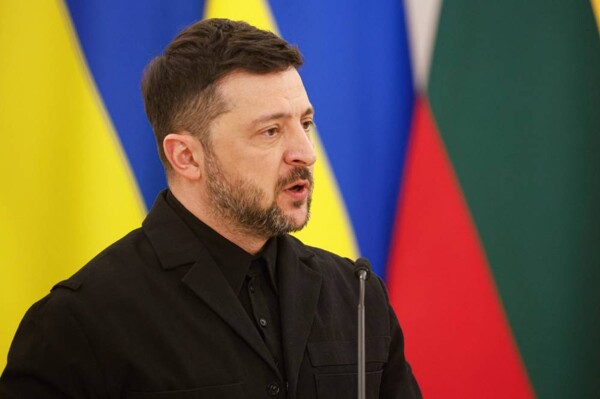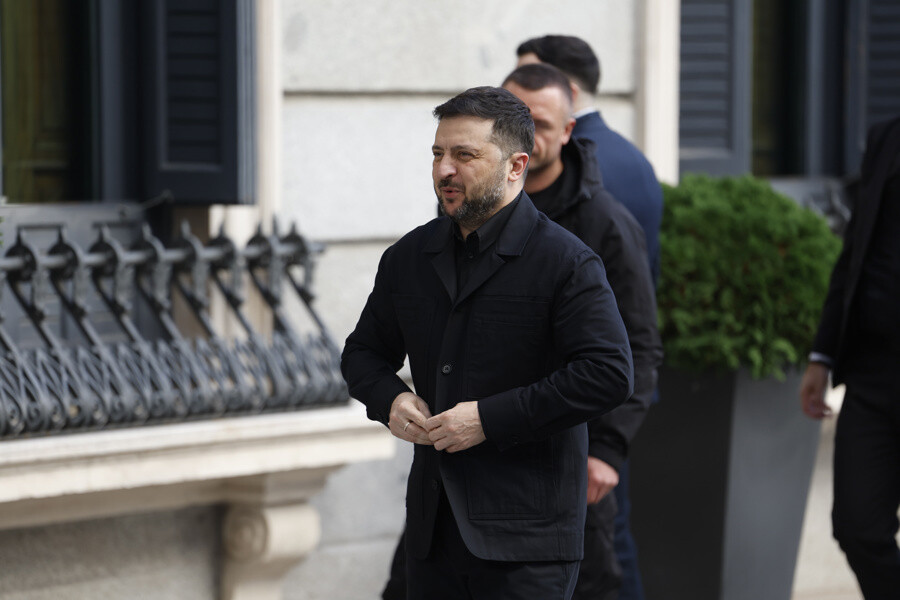
Ukrainian President Volodymyr Zelensky is counting on greater support from European partners and consensus within Ukraine as he faces intense pressure from Washington to accept an unfavorable peace deal with Russia. Zelensky, whom U.S. President Donald Trump claims has 'no cards to play' on the battlefield, appears weakened after a corruption scandal involving several ministers, leading to demands for changes in his administration. Many in Ukraine remain critical of Zelensky's handling of the scandal and his failure to address long-standing challenges that undermine the country's defense. However, the majority will likely heed his call for 'unity' in supporting the president, whose team will make a new attempt in Geneva tomorrow to soften the terms sought by the American plan. While some Ukrainians, exhausted by four years of invasion, see 'a bad peace' as preferable, many believe that accepting the American terms would mean 'capitulation' and leave Ukraine defenseless against a likely future Russian aggression. 'Better a harsh winter than the loss of sovereignty,' wrote Maksym Kolesnykov, a Ukrainian army veteran who spent a year in Russian captivity, referencing a phrase Zelensky uttered on Friday. Ukraine, the head of state said, faces a difficult choice: 'to lose dignity or risk losing a key ally,' the U.S., or 'to accept 28 tough points or an extremely difficult winter' as Russia continues to gradually advance on the front and massive power outages persist due to Russian attacks. 'Better to lose all U.S. support than to hand over 6,000 square kilometers and several hundred thousand people of Donbas without a fight.' U.S. support under the Trump administration has decreased, weakening its influence over Ukraine, but the military intelligence it provides remains vital for Ukrainian attacks on the Russian rear. This gives Russian President Vladimir Putin valid reasons to believe that Ukraine will face even worse conditions if it rejects the plan now, wrote former Ukrainian Foreign Minister Dmytro Kuleba. The choice facing Ukraine is 'to fight for at least some changes in the plan and then accept its final version' or 'to keep resisting' in the hope that circumstances will change and more weapons and sanctions will eventually alter the balance, he noted. Europe's Role In preparation for the consultations in Geneva, Zelensky has again turned to the support of European partners, plus Canada and Japan, who stated in a joint communiqué on Saturday that the plan needs adjustments. Alongside the protection that European leaders have already provided to Zelensky against pressure from Washington, which wants a response from Kyiv by next Thursday, Europe's role in sustaining Ukraine's defense has also been growing. However, there is also frustration in Ukraine over what is perceived as the EU's inability to make quick decisions, failing to approve a loan financed by frozen Russian assets despite the fear of having to face Moscow alone if the U.S. withdraws and Ukraine falls under Russian control. These funds, argues Mykola Bielieskov of the Ukrainian Institute of Strategic Studies, could 'stabilize the situation and become a counterargument to the American plan.' Moreover, if the EU were to block Russian tankers from passing through the Baltic Sea and Danish straits, crucial for Moscow's exports, it could impose conditions on Russia instead of just reacting to its actions, said Andrii Klimenko of the Black Sea Research Institute in a separate interview with EFE. 'Better to continue the resistance than to open the way to total occupation in a couple of years for the illusion of peace,' argued Kolesnykov on X. He referred to the point in Trump's plan that contemplates the cession of Donbas in the east to Russia and the freezing of the current front in the southern regions of Zaporizhzhia and Kherson, as well as the de facto official recognition of the occupied Crimean Peninsula as Russian. A Difficult Choice According to recent polls, most Ukrainians believe that freezing the combat along the current front line, as well as reliable security guarantees against new aggressions, should be the basis for any negotiation. At the same time, the situation on the front is perceived as deteriorating amid an increase in desertions and lower-than-expected external support. Although U.S. military support under Trump has decreased, weakening its influence over Ukraine, the military intelligence it provides remains vital for Ukrainian attacks on the Russian rear. This gives Russian President Vladimir Putin valid reasons to believe that Ukraine will face even worse conditions if it rejects the plan now, wrote former Ukrainian Foreign Minister Dmytro Kuleba. The choice facing Ukraine is 'to fight for at least some changes in the plan and then accept its final version' or 'to keep resisting' in the hope that circumstances will change and more weapons and sanctions will eventually alter the balance, he noted. Europe's Role In preparation for the consultations in Geneva, Zelensky has again turned to the support of European partners, plus Canada and Japan, who stated in a joint communiqué on Saturday that the plan needs adjustments. Alongside the protection that European leaders have already provided to Zelensky against pressure from Washington, which wants a response from Kyiv by next Thursday, Europe's role in sustaining Ukraine's defense has also been growing. However, there is also frustration in Ukraine over what is perceived as the EU's inability to make quick decisions, failing to approve a loan financed by frozen Russian assets despite the fear of having to face Moscow alone if the U.S. withdraws and Ukraine falls under Russian control. These funds, argues Mykola Bielieskov of the Ukrainian Institute of Strategic Studies, could 'stabilize the situation and become a counterargument to the American plan.' Moreover, if the EU were to block Russian tankers from passing through the Baltic Sea and Danish straits, crucial for Moscow's exports, it could impose conditions on Russia instead of just reacting to its actions, said Andrii Klimenko of the Black Sea Research Institute in a separate interview with EFE. 'Better to continue the resistance than to open the way to total occupation in a couple of years for the illusion of peace,' argued Kolesnykov on X. He referred to the point in Trump's plan that contemplates the cession of Donbas in the east to Russia and the freezing of the current front in the southern regions of Zaporizhzhia and Kherson, as well as the de facto official recognition of the occupied Crimean Peninsula as Russian.