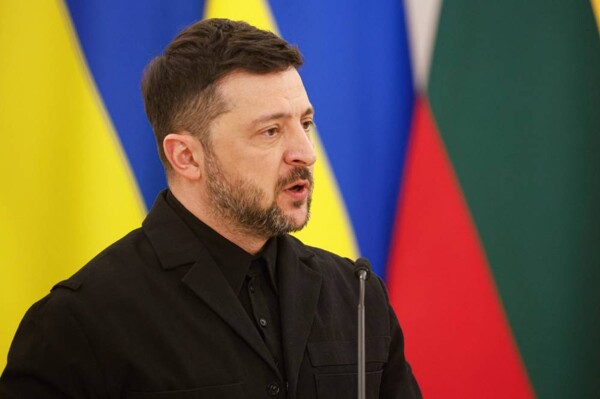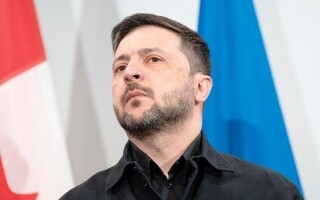
Ukrainian President Volodymyr Zelensky has expressed a new readiness to make concessions on key negotiation points that threatened to hinder the fledgling peace process with Moscow, effectively placing the ball in Russia's court. In a frank and comprehensive meeting with journalists last Tuesday, Zelensky revealed new details of a 20-point plan, which he described as: 'a foundational document for ending the war, a political document between us, America, Europe, and Russia.' The Ukrainian president also discussed the details of security guarantees between Ukraine, the United States, and European countries, which will form a core part of any peace agreement with Russia. Zelensky stated that he 'expects a response from Moscow after the American side contacts the Kremlin.' The 20-point agreement project is a condensed version of an original 28-point plan previously discussed by the United States with the Russian side. In his remarks, Zelensky explained that the Ukrainian side had proposed a compromise solution for withdrawing its troops from parts of the Donetsk region in eastern Ukraine that are not currently controlled by Russian forces. This area includes the 'belt of fortifications,' which includes fortified Ukrainian cities such as Kramatorsk and Sloviansk in the Donetsk region, and currently stands as an obstacle to any potential Russian advance into Ukrainian territory. Russian President Vladimir Putin had stated that Ukraine must actually cede all of Donetsk for the peace plan to succeed. In explaining his country's position, Zelensky said: 'Russia will be forced to withdraw its troops by an amount of land equivalent to what the Ukrainian forces have ceded, which will actually create a demilitarized zone around some current front lines.' He added: 'If we create a free economic zone here that actually includes a demilitarized zone, meaning the withdrawal of heavy weapons from this area, and the distance is, for example, 40 kilometers (it could be five, 10, or 40 kilometers), and if these two cities (Kramatorsk and Sloviansk) are our free economic zone, then the Russians will have to withdraw their troops accordingly by five, 10, or 40 kilometers.' Draft PlanAmong other key points in the draft plan outlined by Zelensky, including proposed amendments from Kyiv: affirmation of Ukraine's sovereignty, a non-aggression treaty between Russia and Ukraine, and security guarantees provided to Ukraine by the United States, NATO, and European countries, which Zelensky said 'reflect Article 5'—the fundamental principle of collective defense in NATO. The plan provides for a military response and the reimposition of sanctions on Moscow in the event of a war between Russia and Ukraine, but these guarantees will be voided if Ukraine attacks Russia or fires on Russian territory without provocation. Also among the points: a development package to support Ukraine's post-war economic recovery, including the creation of a Ukrainian development fund for investment in technology, data centers, and artificial intelligence, as well as investment by American companies in Ukraine's natural gas sector. Zelensky estimated the total economic losses from the war at around $800 billion. The plan also includes a proposed settlement for the operation of the Zaporizhzhia Nuclear Power Plant, which is currently under Russian control. Zelensky said: 'Ukraine proposes that the plant be managed by a joint project between the United States and Ukraine, with 50% of the electricity produced going to Ukraine and the remaining share to the United States.' The draft plan also provides for the withdrawal of Russian troops from the Dnipropetrovsk, Mykolaiv, Sumy, and Kharkiv regions of Ukraine, as well as a legally binding agreement whose implementation and enforcement are guaranteed by a Peace Council chaired by U.S. President Donald Trump, and a comprehensive ceasefire that will take effect immediately upon agreement by all parties. Land control is the most complicated point in any agreement, as well as the potential sequence of events. Zelensky spoke in detail about a possible popular referendum in Ukraine that would formally end the war. Zelensky said: 'The people will then choose: does this end suit us or not? This is the referendum. The referendum requires at least 60 days, and we need a real ceasefire for 60 days, otherwise we will not be able to hold it. In other words, the referendum will not be legitimate.' Zelensky added that he does not expect residents of the areas under Russian control to vote honestly. He continued: 'But in the areas we control, we can hold a legitimate and honest referendum. The voting and preparation process must be the same as for the potential elections our partners are talking about, under appropriate security conditions. Without security, legitimacy is called into question, and we are explaining this to all our partners.' PressureUkraine is under pressure to hold elections as soon as possible after an agreement is signed. Putin has always emphasized that the government in Kyiv is illegitimate and that holding elections is necessary for the success of a peace agreement. Zelensky's presidential term ended in 2024, but elections cannot be held under the martial law imposed after the outbreak of war between Russia and Ukraine. The Ukrainian parliament approved these measures introduced during the war. Peace efforts led by the Trump administration, led by U.S. Special Envoy Steve Witkoff and President Donald Trump's son-in-law Jared Kushner, have seen slow progress in recent weeks. Over the weekend, a Ukrainian delegation, led by Ukrainian National Security Advisor Rustem Umerov and Kremlin envoy Kirill Dmitriev, met separately with their American counterparts in talks that Witkoff described as 'constructive and fruitful.' In response to a question about the 20-point plan, Kremlin spokesman Dmitry Peskov remained silent, only saying: 'We are currently analyzing the materials.' He also added that Putin had sent Trump a Christmas greeting. From CNN