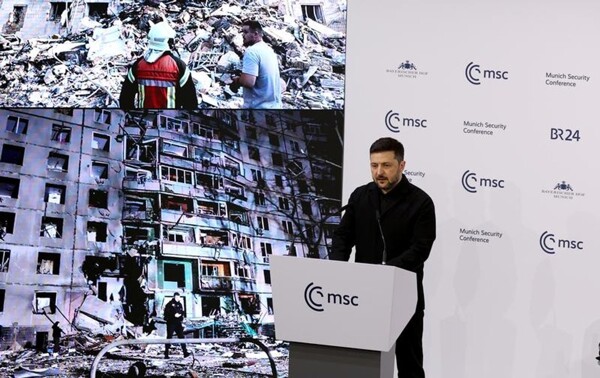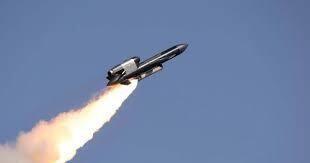
The president of Ukraine, Volodymyr Zelensky, confirmed that the Ukrainian-made FP-5 Flamingo cruise missile has recently been used against targets within Russia. This marks a qualitative leap for Ukraine's defensive campaign: for the first time, Kyiv has a "heavy missile system" of national production capable of striking in depth without the political range restrictions that often accompany some Western weaponry. The announcement was made during an encounter with journalists on the sidelines of the Munich Security Conference, where Zelensky stated that the Flamingo began to be deployed "a few days ago." He also noted that a previous Russian attack destroyed a missile production line, but manufacturing resumed after relocating it to another site, a move that fits the pattern of industrial dispersion Ukraine has been applying since the start of Russia's full-scale invasion to sustain its defensive capability under bombardments. The most strategically sensitive data on the Flamingo is its declared range: up to 3,000 kilometers. This range far exceeds the distance needed to reach Moscow from Ukrainian territory. With the German Chancellor Friedrich Merz, Berlin maintained public prudence while simultaneously pushing for a policy of greater reserve on the details of military deliveries, arguing to maintain "strategic ambiguity" towards Russia. For Ukraine, the Flamingo announcement serves two simultaneous objectives: to show industrial resilience despite Russian attacks and to warn that, as long as Russia continues to aggress against Ukraine's civilian population and energy infrastructure, Kyiv has tools to respond by striking military and logistical capabilities in depth. That assertion points to a persistent debate among Western partners over the use of long-range weaponry to attack targets in Russian territory, a discussion reignited in Munich regarding the German Taurus missile. In this regard, Zelensky again confirmed that Germany has still not supplied Taurus cruise missiles to Ukraine, despite Kyiv's urgent claims. In parallel, recent reports attributed Flamingo strikes to military installations and depots linked to munitions and explosives, as part of a series of Ukrainian attacks also targeting energy and industrial nodes used by Russia to sustain its war effort. On the political-military front, Zelensky emphasized a key difference with systems supplied by allies: as it is a Ukrainian development, it would not be subject to third-party imposed employment restrictions, at least according to his knowledge. In practice, Moscow is now fully within its range of action, and with that reach autonomy, the system opens a new layer of pressure on infrastructure and military targets across much of Russian territory. The missile carries a large warhead—on the order of a ton—and flies at a subsonic speed, around 850 to 900 kilometers per hour. Its profile prioritizes payload and range, a combination particularly relevant for operations against high-value strategic targets.