Ukrainian soldiers have begun using exoskeletons on the front lines to reduce fatigue and carry out tasks more quickly in a context where modern technologies continue to transform the battlefield in the country invaded by Russia.
The 7th Air Assault Corps of the Ukrainian Armed Forces is deploying these mechanical, wearable devices on the front lines, which enhance human capabilities and alleviate physical effort, following successful tests conducted by its 147th Separate Artillery Brigade under combat conditions in the Pokrovsk direction in the eastern Donetsk region.
«With this exoskeleton, we help soldiers perform their tasks better and more efficiently, get tired less, and do them faster,» said EFE Kyrylo Titaiev, 30, a sergeant major of the brigade's unmanned aerial vehicle unit, who tested the device and observed its effect on the artillerymen.
The introduction of exoskeletons is part of a broader push by the 7th Air Assault Corps to reduce physical strain through engineering solutions. Other systems that could alleviate direct load on the arms could also be introduced in the near future, Titaiev noted.
This development is especially relevant for the Ukrainian Army, where the average age of a soldier exceeds 40 years according to public estimates, and where intense physical demands have continued for over four years of large-scale invasion.
«This will make the work easier for people who have been injured or wounded but still want to continue their military service,» Titaiev indicated.
Artillery and logistics, which involve handling heavy loads, are far from the only areas where exoskeletons could be deployed. The sergeant pointed out that the devices could help infantry soldiers, who often have to walk up to 15 kilometers to their positions with munitions, equipment, and food, because enemy drones make transportation by vehicles very risky. Exoskeletons could reduce the load, increase speed, and allow troops to carry more weight.
However, the use of exoskeletons by infantry still faces challenges, according to sources from the 7th Corps, and further tests and adaptations of the devices are expected. A separate unit of Ukrainian forces, the Russian Volunteer Corps, has also been testing similar devices for possible use in direct combat and has concluded that they require modifications to better integrate with other soldier equipment.
Several models of exoskeletons have been tested by other armies and are entering civilian sectors in logistics and maintenance. The deployment by Ukrainian units represents the first cases of use in real combat conditions.
Beyond the direct health and combat efficiency benefits, the introduction of exoskeletons is giving a morale boost to the soldiers, Titaiev emphasized.
«They could become an important element of the equipment of soldiers of the future,» he stressed.
«The faster a soldier moves, the faster the artillery works and the more precise it becomes,» Titaiev explained. The expansion of drones on the front line has not diminished the role of artillery in repelling mechanized and infantry attacks from Russian forces or for attacking enemy logistics. Knowing that their work helps stop the Russians before they reach the infantry motivates artillerymen to seek solutions that allow them to perform their duties as effectively as possible, added the sergeant.
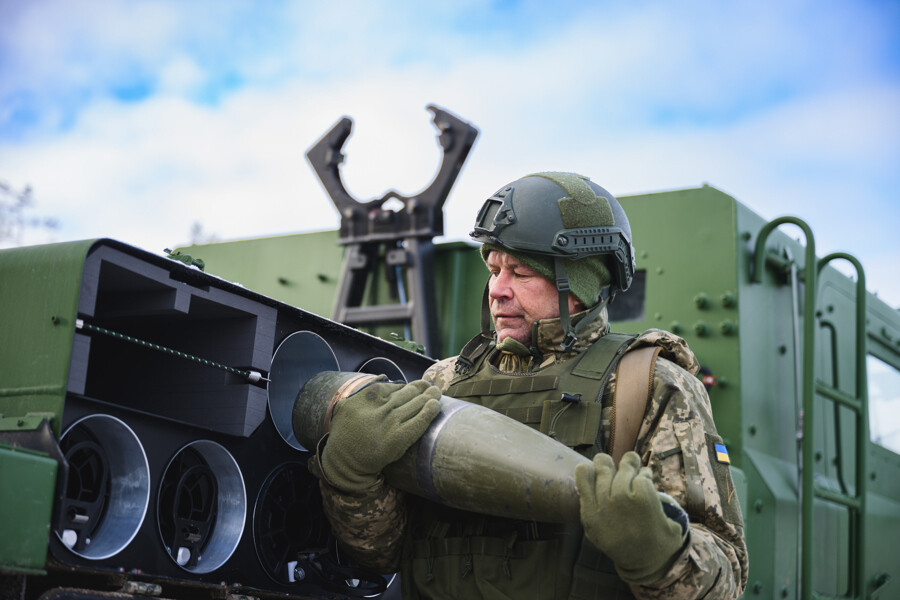
Soldiers operating the French CAESAR self-propelled howitzers and other artillery systems of the unit have to carry 47-kilogram projectiles dozens of meters and load them into the systems several dozen times a day, reaching a daily load of 1,300 kilograms, Titaiev highlighted. The 2-kilogram aluminum exoskeleton fits around the waist and legs, supplementing the soldier's effort and adapting in minutes to movement patterns and terrain type through integrated artificial intelligence (AI) analysis. According to the unit, it reduces the load on the leg muscles and joints, as well as the lumbar region, by up to 30%, while its battery allows for a range of about 17 kilometers. The device folds compactly into a suitcase for transport. «Instead of using, say, 50 projectiles in a day, now they can fire 70».